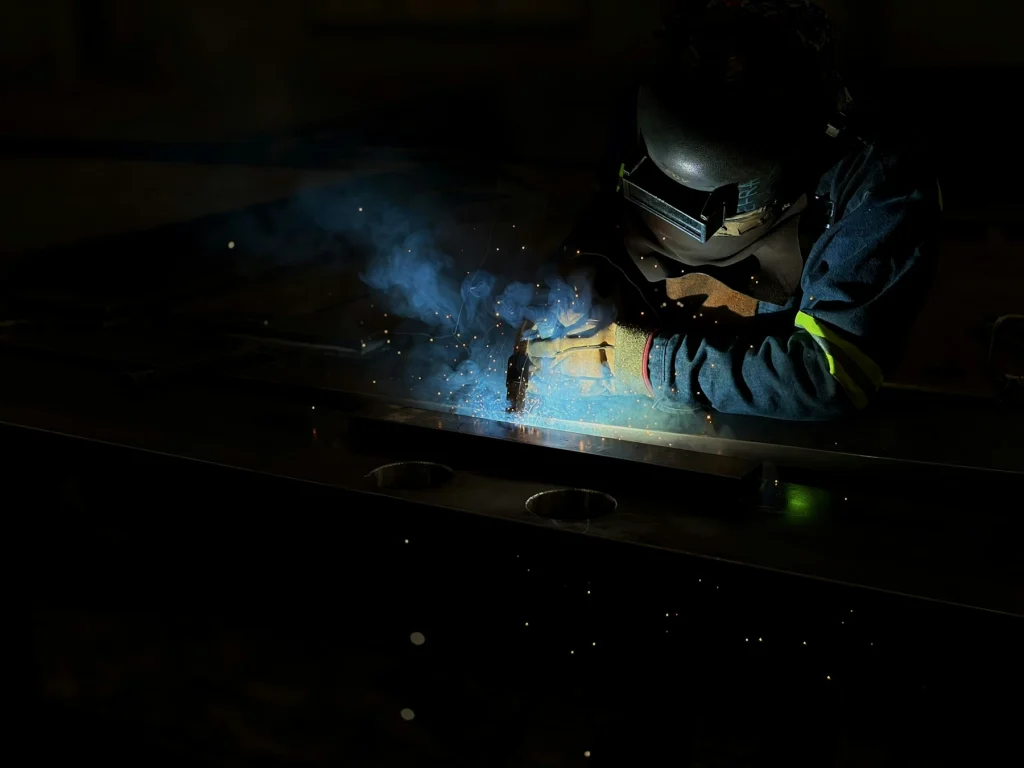
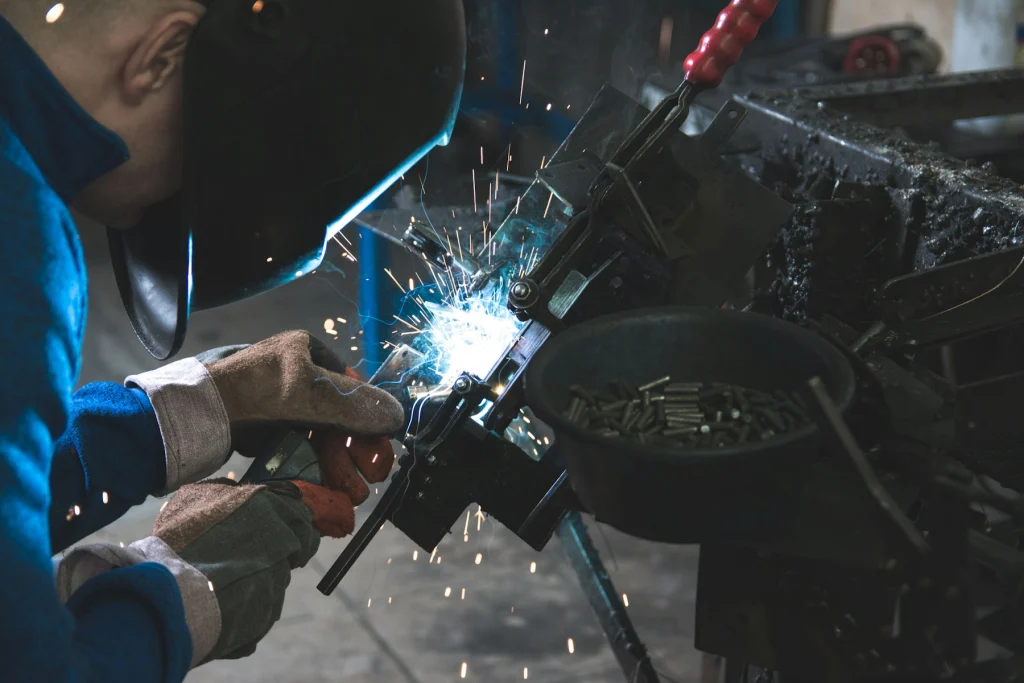
Aluminum welding is harder than welding steel because aluminum has an oxide skin that melts at roughly three times the metal’s own melting point, sheds heat quickly, gives no color warning before melting and cracks with the wrong filler. Professionals get it right with meticulous cleaning, AC TIG or spool-gun MIG, matched filler alloys and tight heat control.
Aluminum is everywhere in Houston: boat trailers and pontoon parts headed to Clear Lake, ladder racks on contractor trucks, food service equipment, truck toolboxes, marine railings and the frames of countless light-industrial machines. When it cracks, many people discover that the shop that welds their steel trailer will not touch aluminum, or that a previous repair failed within weeks. This guide explains why aluminum is different, what equipment and technique it takes, and how to tell whether a part is worth repairing.
Key takeaways
- Aluminum’s oxide layer melts at a much higher temperature than the base metal, so it must be removed mechanically and broken up electrically during welding.
- High thermal conductivity means heat spreads quickly, so aluminum needs more energy to start a puddle and careful control to avoid melting through.
- AC TIG welding and spool-gun or push-pull MIG are the standard processes; ordinary steel MIG setups do not feed soft aluminum wire reliably.
- Filler choice, usually 4043 or 5356, depends on the base alloy, color match, strength needs and whether the part will be anodized.
- Heat-treated alloys such as 6061-T6 lose strength near the weld, so repairs may need reinforcement to restore capacity.
Why is aluminum harder to weld than steel?
A skilled steel welder can still struggle with aluminum the first several times. The metal behaves differently in nearly every way that matters at the arc.
The oxide layer problem
Aluminum reacts with air almost instantly, forming a thin, hard layer of aluminum oxide. That layer is why aluminum resists corrosion so well. It is also the welder’s first obstacle. Aluminum oxide melts at around 3,700 degrees Fahrenheit, while aluminum itself melts at around 1,220 degrees. If the oxide is not removed, the base metal can melt underneath a crust that refuses to fuse, leaving lack-of-fusion defects and inclusions in the weld.
Heat goes everywhere
Aluminum conducts heat several times faster than mild steel. When you strike an arc, heat races away from the joint into the surrounding metal. That means more amperage is needed to start a puddle, and then, as the part warms up, less is needed to keep it from collapsing. A welder who does not adjust as the part heats will start cold and finish with a hole.
No color warning
Steel glows red, then orange, then yellow as it approaches melting, giving visual cues. Aluminum stays silvery until it suddenly turns liquid. Thin aluminum can go from solid to a hole in a fraction of a second with no warning.
Porosity and hydrogen
Molten aluminum absorbs hydrogen readily, and that hydrogen forms gas bubbles as the weld solidifies. The hydrogen comes from moisture, oil, grease, paint and even the hydrated oxide on old aluminum. In a humid climate like ours, aluminum stored outdoors or brought in from a boat often carries enough surface moisture and contamination to cause porosity unless it is cleaned and sometimes gently preheated to drive moisture off.
Hot cracking
Some aluminum alloys are prone to cracking as the weld cools if the filler chemistry is wrong or the joint is restrained. Choosing a compatible filler and managing heat input help prevent this.
How do professionals prepare aluminum for welding?
Most aluminum weld failures start before the arc is struck. Preparation is where professionals spend the extra time.
- Degrease first. Acetone or a dedicated aluminum cleaner removes oil, grease and residue. Wire brushing before degreasing can push oil into the surface.
- Remove the oxide. A stainless steel wire brush used only on aluminum scrubs the oxide layer off the joint area. Brushes that have touched carbon steel transfer iron particles that cause corrosion and contamination.
- Strip coatings. Paint, powder coat and anodizing must be removed from the weld zone, since anodizing is a thick, deliberately created oxide that welds poorly.
- Weld soon after cleaning. The oxide begins to re-form immediately, so cleaning hours or days ahead defeats the purpose.
- Dry out old or wet parts. Boat and trailer parts that have been in water may need warming to drive out moisture before welding.
Which welding process works best for aluminum?
AC TIG welding
Gas tungsten arc welding, commonly called TIG, is the precision choice for aluminum. Alternating current switches polarity many times per second. The electrode-positive portion of the cycle blasts away the oxide in a cleaning action, while the electrode-negative portion drives heat into the work. Modern inverter machines let the welder adjust that balance and the frequency to suit the job. TIG gives excellent control on thin sheet, intricate repairs and visible welds, but it is slower than MIG. It is our go-to process for marine parts, food service equipment and cosmetic work.
Spool-gun and push-pull MIG
Aluminum wire is soft. Pushing it through a standard MIG gun’s long liner tends to cause bird-nesting, where the wire tangles at the drive rolls. A spool gun mounts a small wire spool right on the gun, so the wire only travels a few inches. Push-pull systems use motors at both ends. Either approach, with pure argon shielding gas, makes MIG welding aluminum fast and practical for thicker sections such as trailer frames, boat trailer bunks and heavy brackets.
What about stick and flux-core?
Aluminum stick electrodes exist, but they are difficult to use and produce rough welds with flux that must be thoroughly removed to prevent corrosion. Flux-core is not a practical option for aluminum. For field repairs, a spool gun or a portable TIG machine with argon is the professional standard.
Shielding gas
Pure argon is the standard shielding gas for aluminum with both TIG and MIG. Argon-helium blends add heat for thicker sections. The carbon dioxide blends used for steel MIG welding are not suitable for aluminum. Wind is a particular challenge outdoors, since a breeze can strip shielding gas away and cause porosity; on-site aluminum work often needs wind screens.
Thin sheet versus thick plate
Thickness changes the approach as much as alloy does. Sheet in the range found on toolboxes, diamond plate covers and boat consoles burns through easily, so it calls for lower amperage, a smaller tungsten, faster travel and often a copper or aluminum backing bar that pulls heat away from the joint. Thick plate and heavy extrusions, such as trailer tongues and dock brackets, soak up heat so quickly that the first inch of weld can lack fusion unless the part is preheated or the welder uses more current, a helium blend or a spool gun with larger wire. A good aluminum welder reads the part and changes settings as the job progresses rather than running one setting start to finish.
Filler metals: 4043 versus 5356
The two most common aluminum fillers serve different purposes, and choosing the wrong one can lead to cracking, weak joints or a poor color match.
- 4043 contains silicon. It flows smoothly, resists hot cracking well and is forgiving to weld. It is softer and turns gray if the part is later anodized.
- 5356 contains magnesium. It produces stronger welds, especially in shear, and is a better color match after anodizing. It is stiffer and feeds more easily through a MIG gun, but it is not recommended for parts that will see sustained high service temperatures.
Base alloy matters too. Common structural alloys such as 6061 and marine alloys such as 5052 and 5083 each pair best with particular fillers. A professional checks the alloy, the service conditions and the finish requirement before choosing.
Does welding weaken aluminum?
Often, yes, and this surprises many people. Heat-treated alloys such as 6061-T6 get their strength from a precise heat treatment. Welding heat partially undoes that treatment in the heat-affected zone, and the as-welded strength there is substantially lower than the original temper. Non-heat-treatable alloys such as 5052 are affected less, though cold-worked tempers still soften near the weld.
This is why aluminum trailer and ladder rack repairs often include reinforcement. A crack in a 6061-T6 crossmember that is simply welded closed may break again just beside the weld. Adding a doubler plate, gusset or longer weld path spreads the load over sound material. For truly structural components, an engineer may need to evaluate the repair.
Repair or replace?
Not every cracked aluminum part should be welded. Repair usually makes sense when the crack is local, the surrounding metal is clean and sound, and the part is expensive or slow to replace, as with a custom boat trailer or a fabricated ladder rack. Replacement often wins when the part is an inexpensive stock extrusion, when cracks keep returning in the same spot because the design is undersized, or when corrosion has pitted the metal deeply. Thin aluminum that has been welded several times before can also become difficult to repair cleanly. A written quote should tell you which side of that line your part falls on.
Can cast aluminum be welded?
Cast aluminum parts such as transmission housings, outboard brackets, pump housings and some boat hardware can sometimes be welded, but they are less predictable. Castings may contain porosity, absorbed oil or alloys that do not weld well. Porosity often bubbles up through the puddle as the casting heats. A careful TIG welder can repair many castings, especially for non-critical cracks, but a replacement part may be the more reliable option when the casting is heavily contaminated or load-bearing.
Common aluminum welding repairs in the Houston area
Living near the Gulf means a lot of aluminum around boats, trailers and coastal properties. Common jobs include:
- Boat trailer frames, bunks and cross members cracked from fatigue and launch ramps.
- Pontoon and deck boat railing, brackets and fittings.
- Truck ladder racks, toolboxes and headache racks, which we cover in our guide to truck bed, flatbed and headache rack repairs.
- Commercial kitchen equipment, carts and shelving.
- Light industrial frames, guards and enclosures.
- Dock ladders, gangway parts and coastal railings.
Our stainless and aluminum welding service brings AC TIG and spool-gun MIG equipment on-site, and we also handle aluminum parts on trailers through our trailer and truck repair work.
Aluminum repair checklist
Use this before calling a welder for an aluminum part.
- Identify the part and, if possible, the alloy; look for stamps, manufacturer labels or documentation.
- Note whether the part is cast or wrought; castings often have a rough, grainy surface.
- Photograph the crack or break from several angles with a ruler or tape measure in the frame.
- Rinse off salt, mud and marine growth, and let the part dry.
- Remove nearby plastic, wiring, fuel lines and upholstery if possible.
- Tell the welder whether the part is load-bearing, such as a trailer frame or ladder rack.
- Mention whether the part will be anodized, painted or left bare afterward.
- Ask whether reinforcement is recommended for heat-treated alloys.
- Consider whether a replacement part is readily available and how its cost compares.
Frequently asked questions
Can you weld aluminum with a regular MIG welder?
Not reliably with a standard setup. Soft aluminum wire tangles in long MIG liners, and aluminum needs pure argon rather than the carbon dioxide blends used for steel. A spool gun or push-pull system with argon makes MIG welding aluminum practical. For thin or cosmetic work, AC TIG gives better control.
Why did my aluminum weld crack next to the bead?
Heat-treated alloys such as 6061-T6 lose strength near the weld, so the metal beside the bead can become the weakest point. Cracking can also come from the wrong filler, contamination or a design that concentrates stress. Repairs often need reinforcement, and the root cause should be addressed so the crack does not return.
Is aluminum welding more expensive than steel?
Usually somewhat, because aluminum needs more preparation, specialized equipment, argon gas and closer attention to heat control. The difference depends on the part, the alloy, access and whether reinforcement is needed. We provide written quotes that explain what is involved rather than a flat rate.
Can you weld aluminum on my boat or trailer on-site?
In many cases, yes. Our mobile setup includes TIG and spool-gun MIG equipment with argon, plus wind screens for outdoor work. The part must be safely accessible, cleaned of fuel and marine growth, and away from fuel vapors. Some repairs are better done after removing the part, which we will discuss when quoting.
How can I tell if a part is aluminum or stainless?
Aluminum is much lighter than stainless steel for the same size part, and a magnet does not stick to either aluminum or most common stainless grades, so weight is often the giveaway. Aluminum also scratches more easily and tends to look duller. If in doubt, include a photo and a description of the part in your quote request.
Aluminum rewards experience and punishes shortcuts, and a weld that looks fine can still fail if the cleaning, filler or heat control was off. If you have an aluminum trailer, boat part, rack or equipment frame that needs repair, send photos and details through our Get a Quote form. We work across the Houston region, including boat owners in The Woodlands near Lake Conroe, and we will reply with a free written quote that explains the process and any reinforcement we recommend.