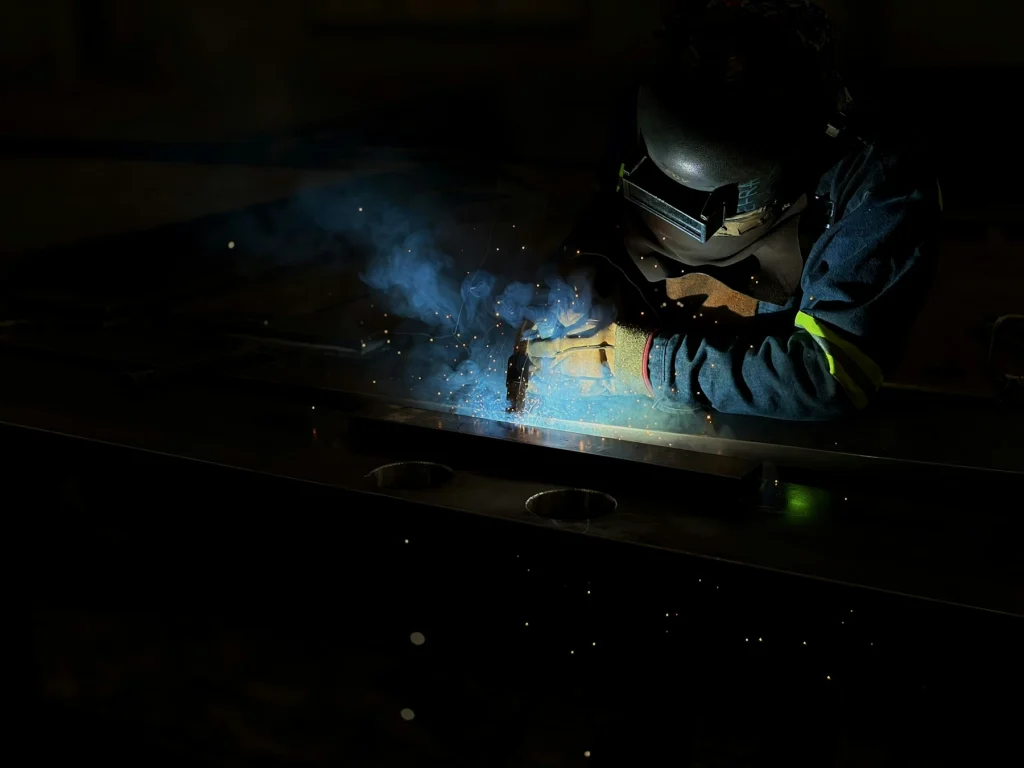

Rust protection for welded steel on the Gulf Coast comes down to three things: removing scale, spatter and flux that trap moisture at the weld, sealing every joint so water cannot sit in it, and putting a coating system over clean metal before Houston humidity gets to it. Skip one and the weld zone usually rusts first.
That is the short version. The longer version matters because welded steel fails in a very particular way along the Texas coast, and most of the rust calls our crew answers trace back to decisions made the day the steel was welded, not years later. This guide walks through why welds corrode faster here, which coatings hold up, how galvanized and stainless parts fit in, and what a sensible maintenance routine looks like for gates, trailers, railings and light industrial steel.
Key takeaways
- The weld and the heat-affected zone next to it are almost always the first places rust shows up, because heat burns off factory coatings and leaves rough, porous surfaces behind.
- Houston humidity, frequent dew, summer storms and salt air near Galveston Bay keep steel wet for long stretches, which is what drives corrosion more than rainfall totals alone.
- Continuous seal welds, drain holes and the removal of crevices prevent more rust than any paint can cure later.
- A primer and topcoat system over properly prepared metal outlasts a single coat of rattle-can enamel by a wide margin.
- Galvanized and stainless steel both work well here, but each needs specific welding and touch-up practices to keep its protection intact.
Why does welded steel rust so fast on the Gulf Coast?
Corrosion needs three things: bare iron, oxygen and an electrolyte, which in practice means water carrying dissolved salts or pollutants. Houston supplies the water generously. Relative humidity regularly sits high overnight for much of the year, so steel that cools after sunset collects a film of condensation almost every morning. That film is what scientists call time of wetness, and it is the single best predictor of how fast unprotected steel will rust.
Closer to the bay, the air carries chloride salts. Properties in Baytown, La Porte, Seabrook, Kemah and League City see noticeably more aggressive corrosion than homes in Katy or Cypress, though no part of the metro area is truly dry. Industrial corridors along the Ship Channel add airborne sulfur compounds and particulates that settle on metal and hold moisture against it.
What makes the weld itself vulnerable
The weld bead and the strip of metal on either side of it, known as the heat-affected zone, get hot enough to burn off paint, powder coat, oil and galvanizing. Welding also leaves spatter, slag from stick and flux-core processes, and a heat tint that is rough and slightly porous at a microscopic level. Every one of those features gives moisture a place to cling.
Then there is geometry. A fillet weld creates a sharp internal corner. A stitch weld on a lap joint leaves gaps between the plates. Square tube welded shut at one end but open at the other becomes a cup that holds water. Rust loves these spots because they stay wet long after the rest of the part has dried.
How do you prepare a weld so the coating actually sticks?
Paint does not stop rust. Paint stops water and oxygen from reaching the steel, and it can only do that if it bonds to clean metal with no gaps underneath. Most coating failures we see on Houston gates and trailer frames are adhesion failures: the paint was sprayed over scale, slag or flash rust, and it peeled away within a season or two.
The cleaning steps that matter most
- Chip and brush slag from stick or flux-core welds completely. Leftover slag is hygroscopic, meaning it attracts moisture, and it will push paint off from below.
- Grind or flap-disc spatter and any sharp ridges. Coatings thin out over sharp edges, which is why corners and weld toes often rust before flat faces.
- Remove mill scale on new hot-rolled steel. Mill scale looks like a protective blue-gray skin, but it cracks and flakes, and rust spreads underneath it.
- Degrease with a solvent that does not leave residue. Cutting oil, fingerprints and anti-spatter spray all ruin adhesion.
- Prime the same day. In Houston humidity, freshly ground steel can show flash rust within hours. Priming quickly is not optional here.
Industrial specifications describe these steps using the SSPC and NACE surface preparation standards, ranging from hand-tool cleaning up to near-white abrasive blasting. For a residential gate, careful power-tool cleaning is usually adequate. For trailers, tanks or anything exposed to salt spray, abrasive blasting gives a profile that coatings grip far better.
Which coatings hold up best in Houston humidity?
There is no single best coating. The right system depends on exposure, budget, how easily the part can be recoated and whether it will be handled, scraped or submerged. Here is how the common options compare in practical terms.
Primer and topcoat systems
A zinc-rich primer under an epoxy or urethane topcoat is the workhorse for exterior steel in coastal climates. The zinc in the primer corrodes sacrificially, protecting small scratches, while the topcoat blocks UV and moisture. Epoxy primers bond extremely well and resist moisture but chalk in sunlight, so they need a UV-stable topcoat. Single-component alkyd enamels are easy to apply and touch up, yet they are the least durable choice near salt air.
Powder coating
Powder coating produces a thick, even finish that looks excellent on gates and railings. Its weakness is repair. Once it chips at a weld or hinge, water creeps under the intact coating, and the rust spreads in a blister you cannot see until it bursts. Powder coat performs best when the steel was blasted and pretreated before coating, and when chips are touched up promptly with a compatible paint.
Hot-dip galvanizing
Hot-dip galvanizing dips the finished fabrication into molten zinc, coating inside and out, including the inside of tubes when they are properly vented. For trailer frames, boat lift parts, fence posts and anything near the water, it is one of the most reliable long-term options. Galvanized steel can also be painted afterward, a combination often called a duplex system, which typically lasts longer than either layer alone.
Cold galvanizing compound
Zinc-rich spray or brush-on compounds are touch-up products, not a substitute for a dip. They are the right thing to put over a field weld on galvanized steel, which leads to the next topic.
Welding galvanized steel without losing the protection
Galvanized posts, pipe and angle are common around Houston homes and shops. Welding them is routine, but it requires care. Zinc vaporizes far below the melting point of steel, and breathing zinc oxide fumes can cause metal fume fever, a flu-like illness. A responsible welder grinds the coating back from the joint area before welding and uses ventilation or respiratory protection.
Grinding the zinc off means the weld zone has no protection when the job is done. The fix is simple but often skipped: clean the weld, then apply a zinc-rich cold galvanizing compound across the bead and the ground area, overlapping onto the intact coating. On our gate and security bar repairs, this touch-up is part of the job rather than an extra, because a bare weld on a galvanized post will usually show orange streaks within a few months.
Is stainless steel or aluminum a better choice near the coast?
Sometimes the best rust protection is choosing a metal that does not rust in the usual way. Both stainless steel and aluminum resist corrosion because they form a thin, self-healing oxide film. Both also come with trade-offs.
Stainless steel: 304 versus 316
Type 304 stainless performs well inland, but near salt air it can develop tea staining and pitting. Type 316 contains molybdenum, which improves resistance to chlorides, and it is the usual pick for marine hardware, dock fittings and coastal railings. Stainless also needs proper welding: excess heat causes discoloration and can reduce corrosion resistance in the heat-affected zone, so welds should be cleaned and passivated or at least brushed with a dedicated stainless brush. Using a carbon steel wire wheel on stainless embeds iron particles that rust and stain the surface.
Aluminum
Aluminum does not rust, but it can corrode, especially where it touches other metals. It is light, strong for its weight and popular for boat trailers, ladder racks and marine parts. It is also harder to weld correctly, a subject covered in depth in our guide to why aluminum welding is harder and how pros get it right. Our stainless and aluminum welding service handles both metals with TIG and spool-gun MIG equipment on-site.
Watch for galvanic corrosion
When two different metals touch in the presence of moisture, one of them corrodes faster than it would alone. Aluminum bolted directly to steel, or stainless fasteners in galvanized steel, can create this effect. Insulating washers, sleeves or a barrier coating between the metals prevent it. This is a frequent cause of failure on aluminum trailer fenders and toolboxes mounted to steel frames.
Design details that keep water out of welded joints
Many rust problems are designed in. A few fabrication choices make an outsized difference in a humid climate, and they cost little when built in from the start.
- Seal-weld lap joints instead of stitching them when the parts will live outdoors. A continuous bead closes the crevice; a stitch weld leaves pockets that wick water.
- Cap or drain tubes. Hollow sections should either be fully sealed or drilled with drain holes at their low points so trapped water can escape.
- Avoid flat ledges where water and leaves collect. Sloped tops on brackets and rails shed water.
- Keep steel off the ground. Gate posts set in concrete should have the concrete crowned away from the post so water does not pool at the base, which is where most posts rot through.
- Grind welds smooth on visible surfaces that will be painted. Smoother transitions hold a uniform coating thickness.
What does a sensible maintenance routine look like?
Even the best coating system needs attention in a coastal climate. The goal of maintenance is catching small breaks in the coating before rust undercuts them. A walk-around twice a year, typically in spring before storm season and again in fall, is enough for most residential steel.
What to look for
- Orange staining or bubbling paint along weld lines, hinges and the base of posts.
- Chips at contact points such as latches, gate stops and trailer tie-down rings.
- Flaking powder coat, especially lifting at an edge.
- White powdery deposits on galvanized or aluminum parts, which signal active corrosion of the protective layer.
- Pinholes or thin spots in steel you can tap with a screwdriver, which suggests rust has gone beyond the surface.
When rust becomes a welding problem
Surface rust can be wire-brushed, primed and painted. Once rust has eaten through a section, or a weld has cracked because the metal next to it thinned out, painting only hides the damage. That is the point where cutting out the corroded section and welding in new material is the right call. Trailer crossmembers, gate frame bottoms and hinge plates are the parts we replace most often for this reason, typically through our trailer and truck repair work.
Rust protection for welded steel: a practical checklist
Use this list when you are planning new welded steel or deciding what to do with existing work.
- Ask what coating system will go on after welding, not just whether it will be painted.
- Confirm that slag and spatter will be removed and that the steel will be primed the same day.
- For galvanized parts, confirm the weld areas will get cold galvanizing compound.
- Choose 316 stainless over 304 for hardware within sight of salt water.
- Isolate aluminum from steel and stainless with washers, sleeves or barrier coatings.
- Specify seal welds on outdoor lap joints and drain holes in tubular frames.
- Schedule a spring and fall inspection and keep a can of matching primer and topcoat on hand.
- Rinse salt residue off trailers and boat equipment with fresh water after every coastal trip.
- Replace corroded sections rather than painting over metal that has lost thickness.
Frequently asked questions
How soon after welding should steel be primed in Houston?
Ideally the same day, and within a few hours if the steel was ground or blasted. Houston humidity can produce flash rust on bare steel quickly, especially overnight when dew forms. Priming over flash rust weakens adhesion, so if the steel has already turned orange, it should be cleaned again before coating.
Can I paint over rusty welds?
You can paint over light surface rust after wire-brushing it and applying a rust-converting or rust-inhibiting primer, but results are limited. Heavy scale, flaking rust or pitted metal needs mechanical cleaning first. If the steel has thinned or the weld has cracked, the section should be cut out and rewelded rather than painted.
Is galvanized steel worth the extra step for a gate or trailer?
For anything stored outside near the coast or regularly exposed to salt water, hot-dip galvanizing usually pays for itself through a much longer service life. For inland residential gates that will be powder coated and maintained, a good primer and topcoat system can be adequate. Exposure and how much maintenance you want to do should drive the decision.
Why does rust always start at the weld?
Welding heat burns away the factory coating, leaves spatter and slag, and creates rough surfaces and tight corners that hold moisture. If the weld area is not cleaned and coated as carefully as the rest of the part, it becomes the weakest point in the protection, and rust starts there first.
Do you repair rusted steel on-site?
Yes. Our mobile crew cuts out corroded steel, welds in new material and leaves the repair primed or touched up with the right coating for the metal. We handle gates, railings, trailers, truck beds and light industrial supports across the metro, from humid Katy subdivisions to bayfront properties in Baytown.
Rust on welded steel is predictable in this climate, which means it is also preventable. If you have a gate, trailer, railing or industrial support that is starting to show orange at the welds, send a few photos and a short description through our Get a Quote form. We will reply with questions or a free written quote that explains what needs to be cut out, what can be saved and which coating will give the repair the best chance of lasting through many Gulf Coast summers.